Friday, December 8, 2017

Mechanisms of Toxicity

  • Toxicity involves toxicant delivery to its target or targets and interactions with endogenous target molecules that may trigger perturbations in cell function and/or structure or that may initiate repair mechanisms at the molecular, cellular, and/or tissue levels.
  • Biotransformation to harmful products is called toxication or metabolic activation.
  • Biotransformations that eliminate the ultimate toxicant or prevent its formation are called detoxications.
  • Apoptosis, or programmed cell death, is a tightly controlled, organized process whereby individual cells break into small fragments that are phagocytosed by adjacent cells or macrophages without producing an inflammatory response.
  • Sustained elevation of intracellular Ca2+ is harmful because it can result in (1) depletion of energy reserves by inhibiting the ATPase used in oxidative phosphorylation, (2) dysfunction of microfilaments, (3) activation of hydrolytic enzymes, and (4) generation of reactive oxygen and nitrogen species (ROS and RNS).
  • Cell injury progresses toward cell necrosis (death) if molecular repair mechanisms are inefficient or the molecular damage is not readily reversible.
  • Chemical carcinogenesis involves insufficient function of various repair mechanisms, including (1) failure of DNA repair, (2) failure of apoptosis (programmed cell death), and (3) failure to terminate cell proliferation.
An understanding of the mechanisms of toxicity provides a rational basis for interpreting descriptive toxicity data. The cellular mechanisms that contribute to the manifestation of toxicities are overviewed by relating a series of events that begins with exposure, involves a multitude of interactions between the invading toxicant and the organism, and culminates in a toxic effect.
As a result of the huge number of potential toxicants and the multitude of biological structures and processes that can be impaired, there are a tremendous number of possible pathways that may lead to toxicity (Figure 3–1). Commonly, a toxicant is delivered to its target, reacts with it, and the resultant cellular dysfunction manifests itself in toxicity. Sometimes a xenobiotic does not react with a specific target molecule but rather adversely influences the biological environment, causing molecular, organellar, cellular, or organ dysfunction leading to deleterious effects.
FIGURE 
Potential stages in the development of toxicity after chemical exposure.
The most complex path to toxicity involves more steps above (Figure ). First, the toxicant is delivered to its target or targets (step 1), interacting with endogenous target molecules (step 2a) or altering the environment (step 2b), triggering perturbations in cell function and/or structure (step 3), which initiate repair mechanisms at the molecular, cellular, and/or tissue levels (step 4). When the perturbations induced by the toxicant exceed repair capacity or when repair becomes malfunctional, toxicity occurs. Tissue necrosis, cancer, and fibrosis are examples of chemically induced toxicities that follow this four-step course.

Theoretically, the intensity of a toxic effect depends on the concentration and persistence of the ultimate toxicant at its site of action. 
1.Delivery: Site of Exposure to the Target 2.Reaction of the Ultimate Toxicant with the Target Molecule 3.Cellular Dysfunction and Resultant Toxicity 4.Repair or Dysrepair


Monday, November 20, 2017

ormat: AbstractSend to Pharmacol Rep. 2006 Sep-Oct;58(5):599-613. Prodrugs and soft drugs. Stańczak A1, Ferra A.

 2006 Sep-Oct;58(5):599-613.

Prodrugs and soft drugs.

Abstract

This review focuses on a new approach to the development of drugs, namely on prodrugs and soft drugs. Nowadays, we try to design drugs that heal sick people having the best acceptance of patients. They must be efficient and selective on their site of action and must be metabolized to non-toxic derivatives. Both, prodrugs and soft drugs should have good distributive properties to enhance their quality. They are designed to maximize the amount of an active drug that reaches its target, through changing the physicochemical, biopharmaceutical or pharmacokinetic properties of drugs. Prodrugs are changed into the active drug within the body through enzymatic or non-enzymatic reactions. Soft drugs are novel and active analogues of already known therapeutic agents. It is expected that continued studies will improve drug properties so as to achieve the best drug delivery system.

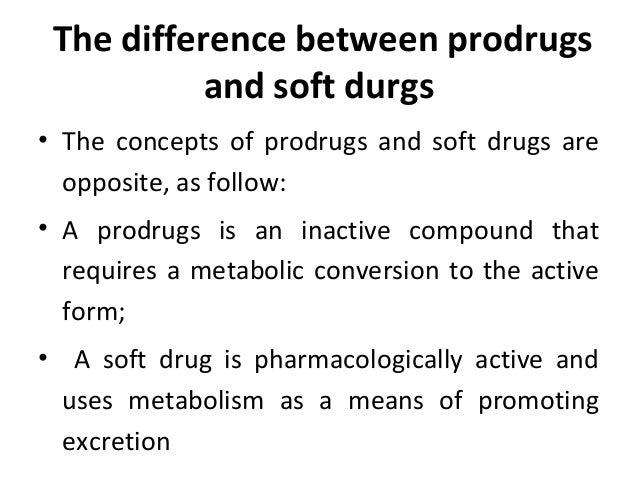
The difference between Prodrugs and Soft Drugs

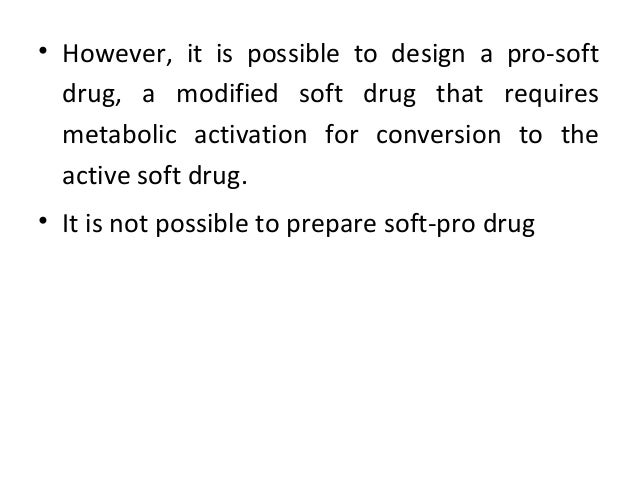
• However, it is possible to design a pro-soft  drug, a modified soft drug that requires  metabolic activation for convers...
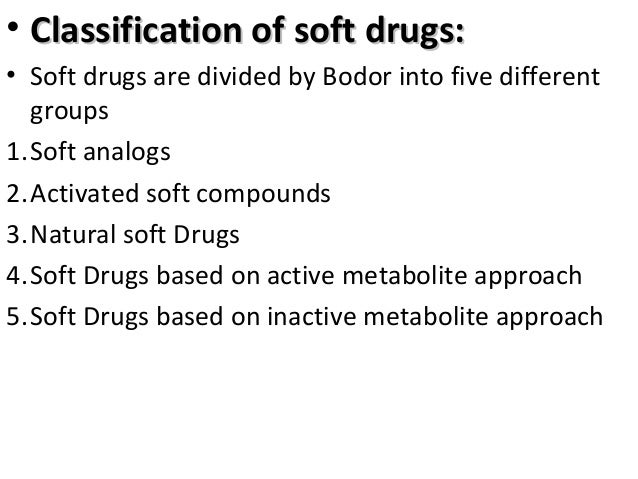
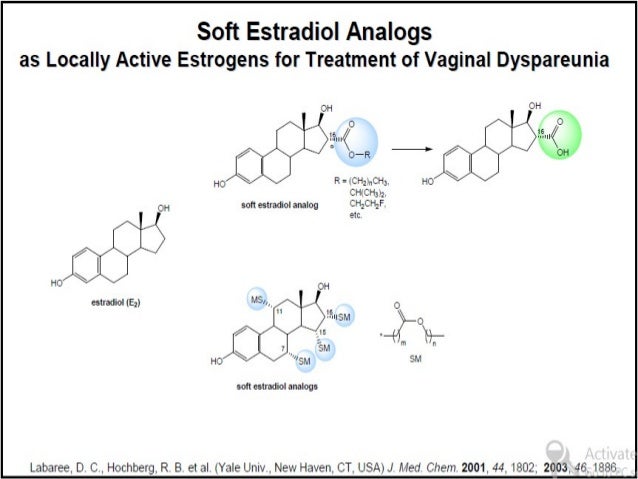
• Classification of soft drugs:• Soft drugs are divided by Bodor into five different  groups1.Soft analogs2.Activated soft...
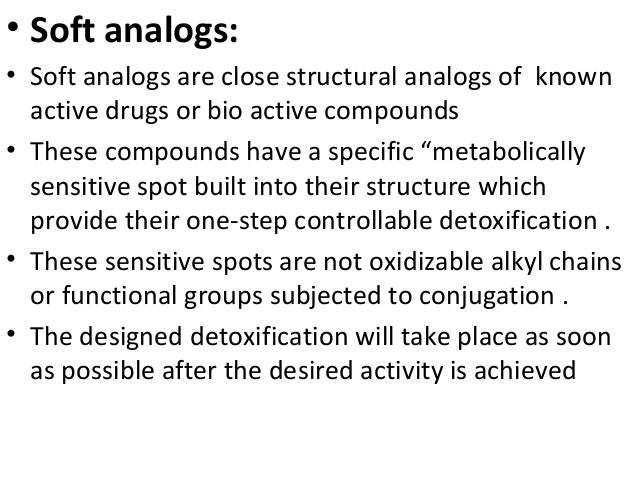
• Soft analogs:• Soft analogs are close structural analogs of known  active drugs or bio active compounds• These compounds...
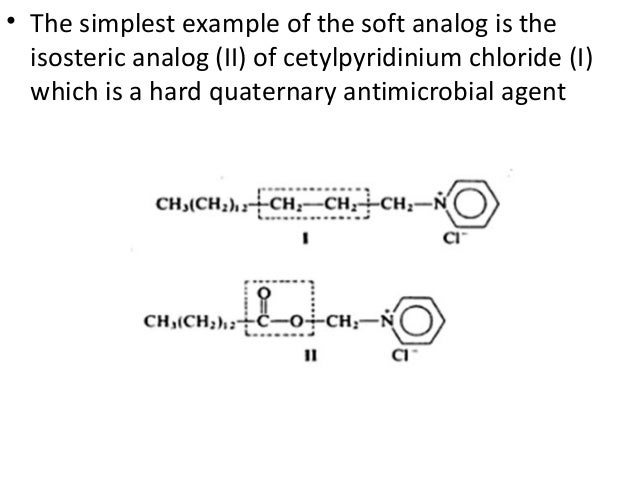
• The simplest example of the soft analog is the  isosteric analog (II) of cetylpyridinium chloride (I)  which is a hard q...
• Activated soft compounds:• These compounds are not the analogs of known  drugs• These are designed by introducing a  pha...
Eg: soft chloramine are less corrosive(where thechlorine atom attached to hetero atom) than theconventional chloraminesEg:...
• Natural soft drugs:• The endogenous substances can be considerd as  natural soft drugs since the body possesses  efficie...
Eg: the use of di esters of adrenalone todeliver the epinephrine the eye via combinedreduction and hydrolysis process .
• Soft Drugs based on active metabolite  approach:• Some drugs under go step wise biotransformation  giving intermediates ...
• Eg: Oxyphenbutazone the active p-hydroxy  metabolite of phenylbutazone• Oxazepam the common active metabolite of  chlord...
• Soft Drugs based on inactive metabolite  approach:• This is done by three stepsa)Activation stage: chemical modification...
c)Controllable metabolism: control of transportand binding properties as well as rate ofmetabolism and pharmacokinetics by...
References:Andrejus Korolkovas ESSENTIALS OF MEDICINAL CHEMISTRY, 2ND EDFriary, R. Jobs in the Drug Industry A Career Guid...
Soft and hard drugs
Soft and hard drugs
Soft and hard drugs
Soft and hard drugs

Pro Drug

prodrug is a pharmacological substance (drug) that is administered in an inactive (or significantly less active) form. Once administered, the prodrug is metabolised in vivo into an active metabolite. The rationale behind the use of a prodrug is generally for absorption, distribution, metabolism, and excretion (ADME) optimization. Prodrugs are usually designed to improve oral bioavailability, with poor absorption from the gastrointestinal tract usually being the limiting factor.
Additionally, the use of a prodrug strategy increases the selectivity of the drug for its intended target. An example of this can be seen in many chemotherapytreatments, in which the reduction of adverse effects is always of paramount importance. Drugs used to target hypoxic cancer cells, through the use of redox-activation, utilise the large quantities of reductase enzyme present in the hypoxic cell to convert the drug into its cytotoxic form, essentially activating it. As the prodrug has low cytotoxicity prior to this activation, there is a markedly lower chance of it "attacking" healthy, non-cancerous cells which reduces the side-effects associated with these chemotherapeutic agents.
In rational drug design, the knowledge of chemical properties likely to improve absorption and the major metabolic pathways in the body allows the modification of the structure of new chemical entities for improved bioavailability. Sometimes the use of a prodrug is unintentional, however, especially in the case of serendipitousdrug discoveries, and the drug is only identified as a prodrug after extensive drug metabolism studies.

Prodrugs and Soft Drugs

Prodrugs
Prodrugs are pharmacologically inactive derivatives of active drugs. They are designed to maximize the amount of active drug that reaches its site of action, through manipulation of the physicochemical, biopharmaceutical or pharmacokinetic properties of the drug. Prodrugs are converted into the active drug within the body through enzymatic or non-enzymatic reactions.
Soft drugs
Drugs are sometimes divided into "hard drugs " and "soft drugs". Hard drugs are "non-metabolizable drugs" or drugs which are metabolized to biologically active metabolites. The metabolites of hard drugs are frequently toxic oxidation products. Soft drugs are drugs which are characterized by a predictable and controllable in vivo destruction (i.e. metabolism) to non-toxic products after they have achieved their therapeutic role.
 
Similarly "hard compounds" can be defined as compounds which do not degrade in the environment or compounds which do it very slowly. Thus, these compounds will lead to progressive pollution of the environment. An example of a hard compound is the insecticide DDT.
 

"Soft compounds" can be defined as biologically active compounds which are readily degraded to non-toxic and biologically inactive degradation products in the environment. The purpose of this project is to design, synthesise and test soft drugs and soft environmental-friendly compounds

How are drugs designed and developed

What is a drug?

  • Drugs are chemical or biological substances that have some kind of physiological? or biochemical? effect on our bodies.
  • They may be single compounds or a mixture of different compounds.
  • Their effects are intended to be beneficial but can cause harmful side effects in some people.
  • All drugs interact with specific ‘targets’ in the body, with the aim of modifying their activity and often resulting in a therapeutic?effect. For example, pain relief.
  • Drug targets are usually proteins? but are in some cases small regions of DNA? or RNA?.
  • Drugs work either by stimulating or blocking the activity of their targets.

How is a drug developed?

  • The development of a new therapeutic drug is a complex, lengthy and expensive process.
  • It can take 10-15 years and over £500 million to develop a drug from an initial concept, test its safety and effectiveness in humans and then get it into the hospital market, this includes:
    • 2-4 years of pre-clinical development
    • 3-6 years of clinical development
    • additional time for dealing with the regulatory authorities.

Stage 1: Drug discovery
  • The first stage of the drug development process is drug discovery.
  • In the past, some drugs have been discovered by accident, for example, penicillin.
  • Today, more systematic approaches are used, such as:
    • high-throughput screening: which allows scientists to test thousands of potential targets with thousands of diverse chemical compounds to identify a new drug-target combination.
    • rational drug design: which involves designing and synthesising compounds based on the known structure of a specific target molecule.
  • While high-throughput screening may identify hundreds of potential lead components, many will be eliminated at the first round of testing. During this round compounds are tested in cultured cells or animals to find out how effective they are and whether they have any toxic effects.
  • Rational drug design develops fewer compounds compared to high-throughput screening. However, these compounds are very specific to the target and use computer-based modelling to achieve this specificity.

Stage 2: Pre-clinical development
  • Pre-clinical testing is used to determine how best to develop the drug for its intended use.
  • It aims to establish how drugs are absorbed and distributed in the body, and how they are broken down and removed from the body.
  • If appropriate, promising drugs may be modified in an attempt to improve their properties in subtle ways in a process called lead optimisation.
  • The results of pre-clinical testing are also used to determine how to best formulate the drug for its intended clinical use, for example whether it would be most effective as a cream, a pill, an injection or a spray.
  • The pre-clinical studies aim to whittle hundreds of compounds down to just a few useful candidate drugs.
  • These few drugs will then be submitted to the appropriate regulatory authorities and, if accepted, the compound can be taken on to clinical development.

Stage 3: Clinical development
  • This is divided into Phases 0, I, II, III and IV.
  • Clinical development, also known as clinical trials, involves testing the drug on human volunteers  to provide more information about its safety and effectiveness.
  • By the end of the clinical development phase, most of the investigational new drugs will have been eliminated on the grounds of safety and effectiveness.
  • Only one or two compounds will be submitted as a new drug application. In the UK, this is known as a market authorisation application.
  • After a drug has been approved by the appropriate regulatory bodies, pharmaceutical companies have a short period where only they have the rights to market the drug (exclusivity) and before other companies can market the same drug.
  • This exclusivity period is used to regain the massive investment required to develop and launch the new drug.
  • After full approval, drug companies must continue to test their drug and monitor feedback from healthcare professionals to ensure the safety and effectiveness of the drug.
  • After launching a drug, new side effects or risk factors may be identified that had not been previously recorded. This is Phase IV of clinical development and is part of the continued monitoring of the effectiveness of the drug in their target patients.
Illustration showing the different stages involved in developing a drug. Image credit: Genome Research Limited
An illustration showing the different stages involved in developing a drug.