Wednesday, January 27, 2010

FLASH POINT AND FIRE POINT


FLASH POINT


The flash point of an oil is the lowest temperature at which it gives off vapors that will ignite for a moment when a small flame is brought near it.

FIRE POINT

The fire point of an oil is the lowest temperature at which the vapors of the oil burn continuously
for at least 5 seconds when a flame is brought near it .

MEASURING FLASH POINT

There are two basic types of flash point measurement: open cup and closed cup.

In open cup devices the sample is contained in an open cup which is heated, and at intervals a flame is brought over the surface. The measured flash point will actually vary with the height of the flame above the liquid surface, and at sufficient height the measured flash point temperature will coincide with the fire pont.The best known example is the Cleveland Open Cup (COC).

There are two types of Closed cup testers: non-equilibrium, such as Pensky-Martens where the vapours above the liquid are not in temperature equilibrium with the liquid, and equilibrium, such as Small Scale (commonly known as Setaflash) where the vapors are deemed to be in temperature equilibrium with the liquid. In both these types the cups are sealed with a lid through which the ignition source can be introduced. Closed cup testers normally give lower values for the flash point than Open cup (typically 5-10 °C) and are a better approximation to the temperature at which the vapor pressure reaches the lower flammable limit.

The flash point is an empirical measurement rather than a fundamental physical parameter. The measured value will vary with equipment and test protocol variations, including temperature ramp rate (in automated testers), time allowed for the sample to equilibrate, sample volume and whether the sample is stirred.

Monday, January 11, 2010


Viscosity
Technically, the Viscosity of an oil is a measure of the oils resistance to Shear.
Viscosity is more commonly known as resistance to flow. If a lubricating oil is considered as a series of fluid layers superimposed on each other, the viscosity of the oil is a measure of the resistance to flow between the individual layers. A high viscosity implies a high resistance to flow while a low viscosity indicates a low resistance to flow.
Viscosity varies inversely with temperature.
Viscosity is also affected by pressure; higher pressure causes the Viscosity to increase, and subsequently the Load-Carrying Capacity of the oil also increases. This property enables use of thin oils to lubricate heavy machinery.
Load-Carrying Capacity also increases as operating speed of the lubricated machinery is increased.
Two methods for measuring viscosity are commonly employed: Shear and Time.
(1) Shear

When viscosity is determined by directly measuring shear stress and shear rate, it is expressed in centipoise (cP) and is referred to as the Absolute or Dynamic viscosity. In the oil industry, it is more common to use Kinematic viscosity, which is the absolute viscosity divided by the density of the oil being tested. Kinematic viscosity is expressed in centistokes (cSt). Viscosity in centistokes is conventionally given at two standard temperatures: 40 °C and 100 °C (104 °F and 212 °F ).
(2) Time
Another method used to determine oil viscosity measures the time required for an oil sample to flow through a standard orifice at a standard temperature. Viscosity is then expressed in SUS (Saybolt Universal Seconds). SUS viscosities are also conventionally given at two standard temperatures: 37 °C and 98 °C (100 °F and 210 °). As previously noted, the units of viscosity can be expressed as centipoise (cP), centistokes (cST), or Saybolt Universal Seconds (SUS), depending on the actual test method used to measure the viscosity.

Viscosity Index
The Viscosity Index, commonly designated VI, is an arbitrary numbering scale that indicates the changes in oil viscosity with changes in temperature. Viscosity index can be classified as follows:
Low VI - below 35
Medium VI - 35 to 80
High VI - 80 to 110
Very High VI - 110 to125
Super VI - 125 to 160
Super High VI - above 160 to 200
United Bio Lube's Bio based Oils, Fluids, and Greases all have a Super High Viscosity Index in the range of 150 - 220.
A high Viscosity Index indicates small oil viscosity changes with temperature. A low viscosity index indicates high viscosity changes with temperature. Therefore, a fluid that has a high viscosity index can be expected to undergo very little change in viscosity with temperature extremes and is considered to have a stable viscosity. A fluid with a low viscosity index can be expected to undergo a significant change in viscosity as the temperature fluctuates.
For a given temperature range, say -18 to 370 °C (0 - 100 °F), the viscosity of one oil may change considerably more than another.
An oil with a VI of 95 to 100 would change less than one with a VI of 80. Knowing the viscosity index of an oil is crucial when selecting a lubricant for an application, and is especially critical in extremely hot or cold climates. Failure to use an oil with the proper Viscosity Index when temperature extremes are expected may result in poor lubrication and equipment failure.

Pour Point
The Pour Point is the lowest temperature at which an oil will flow. This property is crucial for oils that must flow at low temperatures. A commonly used rule of thumb when selecting oils is to ensure that the Pour Point is at least 10 °C (20 °F) lower than the lowest anticipated ambient temperature.

Cloud Point
The Cloud Point is the temperature at which dissolved solids in the oil, such as paraffin wax, begin to form and separate from the oil. As the temperature drops, wax crystallizes and becomes visible. Certain oils must be maintained at temperatures above the cloud point to prevent clogging of filters.

Flash Point and Fire Point
The Flash Point is the lowest temperature to which a lubricant must be heated before its vapor, when mixed with air, will ignite but not continue to burn.
The Fire Point is the temperature at which lubricant combustion will be sustained.
The flash and fire points are useful in determining a lubricants Volatility and Fire Resistance. The flash point can be used to determine the transportation and storage temperature requirements for lubricants.
Manufacturers and Toll Blenders can also use the flash point to detect potential product contamination. A lubricant exhibiting a flash point significantly lower than normal will be suspected of contamination with a volatile product. Products with a flash point less than 38 °C (100 °F will usually require special precautions for safe handling. The fire point for a lubricant is usually 8 to 10 percent above the flash point.
The flash point and fire point should not be confused with the Auto-ignition Temperature of a lubricant, which is the temperature at which a lubricant will ignite spontaneously without an external ignition source.

Acid Number or Neutralization Number
The Acid Number or Neutralization Number is a measure of the amount of potassium hydroxide required to neutralize the acid contained in a lubricant. Acids are formed as oils oxidize with age and service. The acid number for an oil sample is indicative of the age of the oil and can be used to determine when the oil must be changed.

REFERENCE

Renewable Lubricants Manual,Biobased Oils, Fluids, & Greases,Chapter 3,Authored by: Jeffrey S. Marth

Thursday, January 7, 2010

FUNCTION OF LUBRICANTS

The concepts addressed in this chapter are invaluable in understanding the modern lubricant technology .All modern machines require the use of a lubricant. Power generation in such equipment is achieved by the use of engines that mostly comprise metal parts that move against one another.
In many cases, there is metal-to-metal contact that leads to the generation of friction and heat, which results in wear. The extent of wear in equipment depends upon the degree of the metal-to-metal contact, either due to the equipment design or the nature of the operation. For example, the equipment that is designed to experience minimal metal-to-metal contact, as is the case in most parts of an internal combustion engine, there is little friction and wear. However; the parts that are designed to have intimate metal-to-metal contact, such as gears and bearings, wear due to friction is extensive. With respect to the effect of equipment operation on wear, high-speed, low-load operation leads to lower wear than slow-speed, high-load operation. This is because in the former case there is minimal metal-to-metal contact. A lubricant can be a solid, liquid, or gas, and lubrication is its primary function as we have already discussed in my previous lecture.
The usual objective of the lubrication is to lubricate surfaces to minimize direct metal-to-metal contact and, hence, reduce friction and wear. The term lubricant is also loosely applied to many other fluids that do not specifically perform this function. Examples include power and heat transmission fluids, hydraulic fluids, dielectric fluids, process oils, and the others. Lubricant performs many diverse functions, which help protect and prolong the life of the equipment

FUNCTION OF LUBRICANTS
1. Lubrication (reduce friction and wear)—Lubricant helps reduce friction and wear by introducing a lubricating film between mechanical moving parts, such as gears and bearings. Essentially the presence of a lubricating film minimizes the metal-to-metal contact and reduces the force necessary to move one surface against the other, thereby reducing wear and saving energy.
2. Cooling (heat transfer)—Lubricant acts as a heat sink and dissipates the heat away from the critical moving parts of the equipment, thereby decreasing the possibility of the machine component deformation and wear. The heat is either frictional heat that results from the metal surfaces rubbing against one another, such as in gears, or is conducted and radiated heat, which is due to the close proximity of the parts to a combustion source, such as the combustion chamber in an automobile engine.
3. Cleaning and Suspending—Lubricant facilitates smooth operation of the equipment by removing and suspending potentially harmful products, such as carbon, sludge, and varnish, and the other materials, such as dirt and wear debris. This lubricant function is important in operations that involve high operating temperatures, as in the case of an internal combustion engine or a transmission. This is because in these applications the lubricant gets oxidized to form deposit precursors that can separate on hot surfaces and get converted into deposits.
4. Protection—Lubricant prevents metal damage due to oxidation products, corrosion, and wear. It achieves this by forming a physical film on metal surfaces that is impervious to oxygen, water, and acids, or by forming physical and chemical films by additives, such as rust and corrosion inhibitors, extreme-pressure (EP) additives, and anti-wear agents, that are present in the lubricant.
5. Transfer Power—Lubricant is used as a power transfer medium in some applications, for example, in hydraulic systems. The lubricant performs this function in addition to its normal function of lubrication. Examples of equipment that use hydraulics technology include transmissions, circulating systems, lifts used in automotive service stations, log splitters, fork lifts, dump trucks, and underground continuous mining equipment such as drills, loaders, and miners.

REFERENCE
http://www.astm.org/DIGITAL_LIBRARY/MNL/PAGES/MNL11461M.htm
Klamman, Dieter, Lubricants and Related Products, Verlag Chemie, 1984
G. Corsico, L. Mattei, A. Roselli and C. Gommellini, Poly(internal olefins)- Synthetic Lubricants and high-performance functional fluids,, Marcel Dekker, 1999,Chapter 2, p. 53-62,
R.H. Schlosberg, J.W. Chu, G.A. Knudsen, E.N. Suciu and H.S. Aldrich, High stability esters for synthetic lubricant applications, Lubrication Engineering, February 2001, p. 21-26
Collins (2007), “Implementing Phytoremediation of Petroleum Hydrocarbons, Methods in Biotechnology 23:99-108. Humana Press.

Tuesday, January 5, 2010

THEORIES OF LUBRICANT

Fluid film lubrication or thick film lubrication or hydrodynamic lubrication .
When a fluid lubricant is present between two rolling and/or sliding surfaces, a thicker pressurized film can be generated by the movement of the surfaces (velocities). The non-compressible nature of this film separates the surfaces resulting in no metal to metal contact.
  • The condition in which surfaces are completely separated by a continuous film of lubricating fluid is commonly referred to as Hydrodynamic or Fluid Film Lubrication .Thickness of the film should be less a1000 angestrom.
  • 1.The coefficient of friction is very low.
  • 2.The lubricant should have minimum viscosity under working condition .
  • 3.Hydrocarbon oils are effective lubricant .
  • 4.useful in watches,clocks,sewing machines,working under low load and fair speed of parts.

THIN FILM or BOUNDARY LUBRICATION

Boundary Lubrication (sometimes referred to as thin film lubrication) is a condition in which the lubricant film becomes too thin to provide total separation. This may be due to excessive loading, speeds or a change in the fluid’s characteristics. In such a situation, contact between surface asperities (peaks and valleys) occurs. when a continous film of lubricant cannot persist and direct metal to metal is possible due to certain reasons This happen when a shaft starts moving from rest ,or the speed is low , the load is very high ,vicosity of the oil is too low.

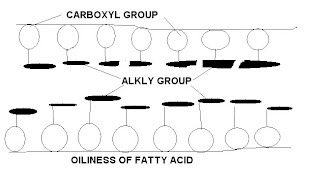
Vegetable and animal oils.,stearic acid ,Oleic acid .

Extreme pressure lubrication :
The contact between the metal surfaces increases and more heat is generated due to increased friction .This results in either decompotion or evaporation of liquid lubricant which renders it ineffective .so extreme pressure additives are used along with lubricant .
Additives are chlorine and sulphur in the form of chlorinated waxes and sulphuried fats .
when the moving /sliding surface are under very high pressure and speed ,a high local temperature is attained and under such condition


Defination of Lubricant

A lubricant is any substance that reduces friction by creating a slippery film between two surfaces. Lubricants permit one surface to move easily over the other surface.
Any substance introduced between moving or sliding surface to reduce the friction in order to aviod or reduce the wear and tear is known as lubricant .
The process of reducing friction between two sliding or moving bodies by the introduction of lubricant is known as lubricant is known as lubrication.

Wednesday, December 30, 2009

Classification of lubricants


Mineral lubricants
Fluid lubricants (Oils)
Mineral fluid lubricants
are based on mineral oils. Mineral oils (petroleum oils) are products of refining crude oil. There are three types of mineral oil: paraffinic, naphtenic and aromatic. Paraffinic oils are produced either by hydrocracking or solvent extraction process. Most hydrocarbon molecules of paraffinic oils have non-ring long-chained structure. Paraffinic oils are relatively viscous and resistant to oxidation. They possess high flash point and high pour point.Paraffinic oils are used for manufacturing engine oils, industrial lubricants and as processing oils in rubber, textile, and paper industries.

Naphtenic oils are produced from crude oil distillates.Most hydrocarbon molecules of naphtenicnic oils have saturated ring structure. Paraffinic oils possess low viscousity, low flash point, low pour point and low resistance to oxidation.Naphtenic oils are used in moderate temperature applications, mainly for manufacturing transformer oils and metal working fluids.Aromatic oils are products of refining process in manufacture of paraffinic oils.Most hydrocarbon molecules of aromatic oils have non-saturated ring structure.

Aromatic oils are dark and have high flash point.Aromatic oils are used for manufacturing seal compounds, adhesives and as plasiticezers in rubber and asphalt production.
Semi-fluid lubricants (greases)
are produced by emulsifying oils or fats with metallic soap and water at 400-600°F (204-316°C).Typical mineral oil base grease is vaseline.Grease properties are determined by a type of oil (mineral, synthetic, vegetable, animal fat), type of soap (lithium, sodium, calcium, etc. salts of long-chained fatty acids) and additives (extra pressure, corrosion protection, anti-oxidation, etc.).Semi-fluid lubricants (greases) are used in variety applications where fluid oil is not applicable and where thick lubrication film is required: lubrication of roller bearings in railway car wheels, rolling mill bearings, steam turbines, spindles, jet engine bearings and other various machinery bearings.
Solid lubricants
Solid lubricants possess lamellar structure preventing direct contact between the sliding surfaces even at high loads. Graphite molybdenum disulfide (MoS2) particles are common solid lubricants. Boron nitride, tungsten disulfide and polytetrafluorethylene (PTFE) are other solid lubricants.Solid lubricants are mainly used as additives to oils and greases. Solid lubricants are also used in form of dry powder or as constituents of coating

Synthetic lubricants
Polyalphaolefins (PAO)
Polyalphaoleins are the most popular synthetic lubticant. PAO’s chemical structure and properties are identical to those of mineral oils.Polyalphaoleins (synthetic hydrocarbons) are manufactured by polymerization of hydrocarbon molecules (alphaoleins). The process occurs in reaction of ethylene gas in presence of a metallic catalyst.
Polyglycols are produced by oxidation of ethylene and propylene. The oxides are then polymerized resulting in formation of polyglycol.Polyglycols are water soluble.Polyglycols are characterized by very low coefficient of friction. They are also able to withstand high pressures without EP (extreme pressure) additives.
Ester oils
Ester oils are produced by reaction of acids and alcohols with water.Ester oils are characterized by very good high temperature and low temperature resistance.
Silicones
Silicones are a group of inorganic polymers, molecules of which represent a backbone structure built from repeated chemical units (monomers) containing Si=O moieties. Two organic groups are attached to each Si=O moiety: eg. methyl+methyl ( (CH3)2 ), methyl+phenyl ( CH3 + C6H5 ), phenyl+phenyl ( (C6H5)2 ).The most popular silicone is polydimethylsiloxane (PDMS). Its monomer is (CH3)2SiO. PDMS is produced from silicon and methylchloride.Other examples of silicones are polymethylphenylsiloxane and polydiphenylsiloxane.Viscosity of silicones depends on the length of the polymer molecules and on the degere of their cross linking. Short non-cross-linked molecules make fluid silicone. Long cross-linked molecules result in elastomer silicone.Silicone lubricants (oils and greases) are characterized by broad temperature range: -100ºF to +400ºF (-73ºC to 204ºC).
Vegetable lubricants
Vegetable lubricants are based on soybean, corn, castor, canola, cotton seed and rape seed oils.Vegetable oils are environmentally friendly alternative to mineral oils since they are biodegradable. Lubrication properties of vegetable base oils are identical to those of mineral oils.The main disadvantages of vegetable lubricants are their low oxidation and temperature stabilities.
Animal lubricants
Animal lubricants are produced from the animals fat. There are two main animal fats: hard fats (stearin) and soft fats (lard). Animal fats are mainly used for manufacturing greases.

GLASSES

Glass is an amorphous, hard, brittle, transparent or translucent, super –cooled liquid of infinity Viscosity, obtained by fusing a mixture of a number of metallic silicates, most commonly of Na, K, Ca and Pb. It possesses no sharp melting point, definite formula or crystalline structure.
Definition amorphous: Having no determinate form; of irregular; shapeless
Definition transparent: Having the property of transmitting rays of light, so that bodies can be distinctly seen through; pervious to light; diaphanous; pellucid; as, transparent glass .
Definition super-cooled :To cool (a liquid) below a transition temperature without the transition occurring, especially to cool below the freezing point without solidification
a glass is defined as an inorganic product of fusion which has been cooled through its glass transition to the solid state without crystallising
General properties of glass
· Glass is amorphous, no definite melting point
· Reflect or transmit light, brittle, softens on heating.
· Electrical insulator
Manufacture of glass
Commercially produced glass can be classified as soda-lime, lead, fused silica, borosilicate, or
96 percent silica. Soda-lime glass, since it constitutes 77 percent of total glass production, is discussedhere. Soda-lime glass consists of sand, limestone, soda ash, and cullet (broken glass).
The manufacture of such glass is in four phases: (1) preparation of raw material, (2) melting in a furnace (3) forming and (4) finishing.
1. Melting: CaCO3+ SiO2 → CaSiO3 + CO2 ↑
Na2CO3+ SiO2 →Na2SiO 3 + CO2↑
The basic three raw materials (quartz sand, limestone, soda ash) with the addition of some oxides which act as catalysts to melt the glass, are made into precise batches and are routed to be melted in a glass furnace, i.e. tank furnace, with standing high temperatures of up to 1600 degrees, to produce molten glass. A charger continuously feeds the batch into the furnace.
2. Forming and shaping: Melting glass is then worked into articles of desired shapes by either blowing or moulding or pressing between rollers.
3. Annealing: Glass articles are then allowed to cool gradually to room temperature by passing through different chamber with descending temperatures. It allowed and cools rapidly, glass being bad conductor of heat, the superficial layer cools down first, leaving the interior portion in a sate of strain. Owing To this unequal expansion, the articles are likely to crack to pieces
4. Finishing: Cleaning, grinding, polishing, cutting, sand – blasting, etc.
5. Inspection: The glass containers are channeled individually through inspection stations and are checked for dimensional accuracy, body and neck quality. Inspection can be manual, semi-automatic or automatic to optimize quality.
6-Packing: After the inspection stations, the glass containers are put on pallets and protected with shrink-wrap ensuring safe delivery to its customers
The observation that old windows are often thicker at the bottom than at the top is often offered as supporting evidence for the view that glass flows over a matter of centuries. It is then assumed that the glass was once uniform, but has flowed to its new shape, which is a property of liquid . The pieces were not, however, absolutely flat; the edges of the disk became thicker as the glass spun. When actually installed in a window frame, the glass would be placed thicker side down both for the sake of stability and to prevent water accumulating in the lead came at the bottom of the window. In glass factories, molten glass was poured onto a large cooling table and allowed to spread. The resulting glass is thicker at the location of the pour, located at the center of the large sheet. These sheets were cut into smaller window panes with nonuniform thickness. Modern glass intended for windows is produced as float glass and is very uniform in thickness.
References
Doremus, R. H. (1994) Glass Science, 2nd Edition. John Wiley & Sons, New York, 339 pp.
Elliott, S. R. (1994) Amorphous Solids: An Introduction. In: Catlow, C. R. A. (eds.), "Defects and Disorder in Crystalline and Amorphous Solids", NATO Advanced Studies Institutes Series; Series C, Mathematical and Physical Sciences, 418, Kluwer Academic Publishers, Dordrecht: 73-86.
Feltz, A. (1993) Amorphous Inorganic Materials and Glasses. VCH Verlagsgesellschaft mbH, Weinheim/VCH Publishers, New York, 446 pp.
definition of glass from 1945; also Glas – Begriffe für Glasarten und Glasgruppen, September 1986
Zallen, R. (1983). The Physics of Amorphous Solids. New York: John Wiley.
Cusack, N. E. (1987). The physics of structurally disordered matter: an introduction. Adam Hilger in association with the University of Sussex press.
Elliot, S. R. (1984). Physics of Amorphous Materials. Longman group ltd.