Sunday, November 12, 2017

Aldol condensation

Aldol condensation is a reaction that results in the formation of a carbon-carbon bond when an enol (or enolate) molecule reacts with an aldehyde (or ketone). ... And an enolate ion is a compound of the anions, or negatively charged molecules, of an enol.
Image result

Mechanism of Condensation Reaction Claisen Condensation Reaction


MECHANISM OF THE CLAISEN CONDENSATION
Step 1:
First, an acid-base reaction. The alkoxide functions as a base and removes the acidic a-hydrogen giving the reactive ester enolate.
mechanism of the Claisen condensation
Step 2:
The nucleophilic ester enolate attacks the carbonyl C of another ester in a nucleophilic substitution processgiving the tetrahedral intermediate.
Step 3:
The intermediate collapses, reforming the C=O, resulting in loss of the leaving group, the alkoxide, leading to the 
b-ketoester product.

The Claisen condensation is an organic reaction used to form a carbon-carbon bond between two ester molecules using an alkoxide base in alcohol to make a β-keto ester. The R group of the ester starting material, the alkoxide base, and the alcohol solvent are chosen to be the same to not end up with a mixture of products. The ester starting material must have an α-hydrogen which is abstracted by the base to form an enolate and alcohol. The enolate then attacks the carbonyl carbon of another ester molecule, an OR group is released to regenerate the base, and the final β-keto ester product is formed. The intramolecular form of the Claisen condensation is the Dieckmann condensation.
  • The Claisen condensation is the ester analogue of the Aldol condensation.
  • Reagents : most commonly the base would be the alkoxide, R'O-
  • The reaction involves an ester enolate reacting with another molecule of the ester.
  • Remember enolates are good nucleophiles and the ester carbonyl C are electrophilic.
  • The products of these reactions are β-ketoesters which are important, useful synthetic intermediates.
  • Note that the product is the original ester with an acyl group added i.e. an acylation reaction has occurred.
  • A simple example of a Claisen condensation is the reaction of ethyl ethanoate which is shown below in two representations.


Sunday, October 29, 2017


E1cB elimination reaction

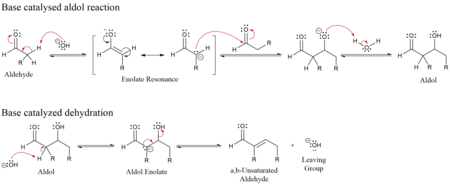
The E1cB elimination reaction is a type of elimination reaction which occurs under basic conditions, where a particularly poor leaving group (such as -OH or -OR) and an acidic hydrogen eliminate to form an additional bond.
 E1cB is a three-step process. First, a base abstracts the most acidic proton to generate a stabilized anion. The lone pair of electrons on the anion then moves to the neighbouring atom, thus expelling the leaving group and forming double or triple bond. 
The name of the mechanism - E1cB - stands for Elimination Unimolecular conjugate Base. Elimination refers to the fact that the mechanism is an elimination reaction and will lose two substituents. Unimolecular refers to the fact that the rate-determining step of this reaction only involves one molecular entity. Finally, conjugate base refers to the formation of the carbanion intermediate, which is the conjugate base of the starting material.
An example of the E1cB reaction mechanism in the degradation of a hemiacetal under basic conditions.
There are two main requirements to have a reaction proceed down an E1cB mechanistic pathway. The compound must have an acidic hydrogen on its β-carbon and a relatively poor leaving group on the α- carbon.
The first step of an E1cB mechanism is the deprotonation of the β-carbon, resulting in the formation of an anionic transition state, such as a carbanion. The greater the stability of this transition state, the more the mechanism will favor an E1cB mechanism. This transition state can be stabilized through induction or delocalization of the electron lone pair through resonance. An example of an E1cB mechanism that has a stable transition state can be seen in the degradation of ethiofencarb - a carbamate insecticide that has a relatively short half-life in earth's atmosphere. Upon deprotonation of the amine, the resulting amide is relatively stable because it is conjugated with the neighboring carbonyl. In addition to containing an acidic hydrogen on the β-carbon, a relatively poor leaving group is also necessary. A bad leaving group is necessary because a good leaving group will leave before the ionization of the molecule. As a result, the compound will likely proceed through an E2 pathway. Some examples of compounds that contain poor leaving groups and can undergo the E1cB mechanism are alcohols and fluoroalkanes. It has also been suggested that the E1cB mechanism is more common among alkenes eliminating to alkynes than from an alkane to alkene.[
One possible explanation for this is that the sp2 hybridization creates slightly more acidic protons. Although it should be noted that this mechanism is not limited to carbon-based eliminations.
It has been observed with other heteroatoms, such as nitrogen in the elimination of a phenol derivative from ethiofencarb.
Degradation of ethiofencarb illustrating the presence of a stable anion due to resonance between the amide functional group and the carbonyl group.

Distinguishing E1cB-elimination reactions from E1- and E2-elimination reactions


E1
E2
E1CB
Stepwise reaction
Concerted reaction
Stepwise reaction
Carbocation Intermediate
removal of proton, formation of double bond, and loss of leaving group
Carbanion intermediate
no kind of conclusion
No preference
kind of conclusion
Good leaving
groupsLeaving group
Poor leaving groups
Less acidic B-H
Acidic B-H
More acidic B-H

When trying to determine whether or not a reaction follows the E1cB mechanism, chemical kinetics are essential. The best way to identify the E1cB mechanism involves the use of rate laws and the kinetic isotope effect. These techniques can also help further differentiate between E1cB, E1, and E2-elimination reactions.